Skip to content




Boiler Repair vs Replacement Cost in Oklahoma City
Boiler repairs in Oklahoma City typically cost between $150 and $750 for common fixes, while a full boiler replacement runs $3,500 to $10,000 depending on fuel type and efficiency rating. If your repair bill exceeds 50% of what a new boiler would cost, replacement is almost always the smarter move. This guide breaks down the exact numbers, warning signs, and decision rules so you can choose confidently.
Key Takeaways
- Common boiler repairs range from $100 to $750, while major component failures like a heat exchanger can exceed $1,500
- Full boiler replacement costs between $3,500 and $10,000 installed, depending on fuel type and efficiency
- The 50% rule is the industry standard: if a single repair costs more than half of a new boiler, replace it
- High-efficiency boilers (95%+ AFUE) can qualify for a federal tax credit of up to $600
- Oklahoma City’s winter temperature swings put extra stress on aging boilers, making efficiency and reliability critical
How Much Does Boiler Repair Cost in Oklahoma City?
Boiler repair costs in Oklahoma City depend on the specific component, the age of your system, and whether you need emergency service. Most homeowners pay between $150 and $750 for standard repairs, according to common boiler repair costs tracked by Angi. That number can climb significantly when major parts fail.
Common Repairs and Their Price Tags
Here’s what Oklahoma City homeowners can expect to pay for the most frequent boiler issues:
- Thermostat replacement: $100 to $300
- Pressure valve replacement: $150 to $350
- Circulator pump repair: $300 to $600
- Ignition switch or pilot light issues: $150 to $400
- Heat exchanger replacement: $1,000 to $2,500
The heat exchanger is the most critical component. If yours fails, the repair cost alone can approach 50% of a brand-new system. Before committing to that expense, explore whether replacing a heat exchanger makes sense for your situation.
What Drives Repair Costs Up?
Several factors push boiler repair bills higher than the averages above. Older units often require discontinued parts that are harder to source. Gas boiler parts are generally more affordable, while oil boiler components carry a premium due to their complexity.
Emergency repairs also cost more. If your boiler fails on a freezing January night in Oklahoma City, expect after-hours surcharges. Boilers connected to hot water baseboard heating systems may have additional components like zone valves and expansion tanks that add to the total.
What Does a Full Boiler Replacement Cost?
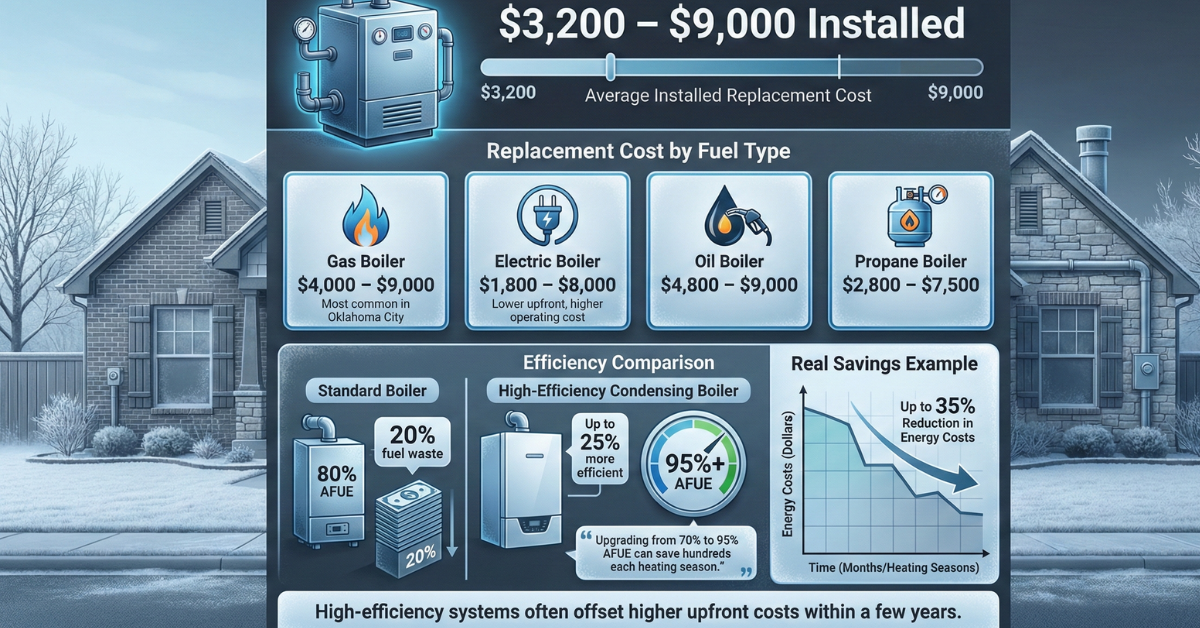
When repairs no longer make financial sense, a full boiler replacement becomes the better investment. According to boiler replacement cost estimates from HomeGuide, most homeowners spend between $3,200 and $9,000 for a new system installed.
Average Replacement Costs by Fuel Type
The fuel type your home uses is one of the biggest factors in replacement pricing:
- Gas boiler: $4,000 to $9,000 installed
- Electric boiler: $1,800 to $8,000 installed
- Oil boiler: $4,800 to $9,000 installed
- Propane boiler: $2,800 to $7,500 installed
Gas boilers remain the most popular choice in Oklahoma City due to widespread natural gas availability. Electric boilers have lower upfront costs but higher monthly operating expenses, making them better suited for smaller homes.
High-Efficiency vs. Standard Models
The efficiency gap between older and newer boilers is dramatic. Standard-efficiency models operate at roughly 80% AFUE (Annual Fuel Utilization Efficiency), meaning 20 cents of every fuel dollar is wasted. High-efficiency condensing boilers reach 95% AFUE or higher, according to the U.S. Department of Energy’s guide to energy-efficient residential gas boilers.
“The efficiency rating tells you exactly how much of your fuel dollar is actually heating your home,” says Daniel Farkas, a licensed mechanical engineer and residential energy auditor with over 20 years of experience. “When you’re comparing an old 70% AFUE boiler to a new 95% AFUE model, that 25-point gap translates to hundreds of dollars in savings every heating season.”
One Oklahoma City family working with AAdvantage upgraded from a 15-year-old system to a high-efficiency unit and saw a 35% reduction in energy costs, often offsetting the higher upfront price within a few years.
Should You Repair or Replace Your Boiler? The 50% Rule Explained
Making the repair-or-replace decision doesn’t have to be a guessing game. HVAC professionals use two straightforward formulas to take the emotion out of the equation.
How the 50% Rule Works
The 50% rule is the industry standard. If the cost of a single repair is 50% or more of a brand-new boiler, you should replace it.
For example, if a new high-efficiency boiler costs $6,000 installed and your repair quote is $3,000, investing that money into an aging system doesn’t make sense. You’d be better off putting that $3,000 toward a new unit with a warranty and lower monthly energy bills.
The Age x Repair Cost Formula
There’s a second formula that factors in your boiler’s age. Multiply the age of your boiler (in years) by the cost of the repair. If the total exceeds $5,000, replacement is recommended, according to boiler installation cost data from Angi. For example, a 12-year-old boiler needing a $500 repair gives you $6,000, which exceeds the $5,000 threshold, making replacement the smarter choice.
“I always tell homeowners to think beyond the immediate repair bill,” says Rich McGill, a certified HVAC technician and boiler specialist with over 15 years of field experience. “A $400 repair on a 14-year-old boiler might seem reasonable today, but when you multiply that by the unit’s age, the math tells a different story. That’s money better spent on a system that will last another 15 to 20 years.”
What Are the Warning Signs Your Boiler Needs Replacing?
Sometimes the decision isn’t about a single breakdown. Your boiler gives you ongoing signals when it’s losing the battle against age and wear.
Performance Red Flags
Pay attention to these indicators that your boiler is struggling:
- Uneven heating throughout your home: Some rooms are warm while others stay cold, pointing to circulation problems or failing zone valves
- Rising energy bills without changes in usage: A jump of 15% to 20% or more suggests your boiler is losing efficiency
- Frequent cycling on and off: Short cycling means the system is working harder, accelerating wear on every component
- Slow recovery time: If reaching the thermostat setting takes noticeably longer, the boiler’s output is declining
Older boilers often operate at just 60% to 70% efficiency, according to ENERGY STAR. That means 30 to 40 cents of every fuel dollar goes up the chimney instead of heating your home.
Safety Concerns You Shouldn’t Ignore
Beyond performance, certain warning signs point to potential safety hazards:
- Banging or clanging noises: Often “kettling” caused by mineral buildup on the heat exchanger, signaling internal stress
- Visible leaks or water pooling: Any moisture around your boiler warrants an immediate professional inspection
- Yellow or flickering pilot light: A healthy gas flame burns blue; a yellow flame may indicate incomplete combustion
- Metallic or sulfur-like odors: Unusual smells near the boiler could signal a gas leak or overheating
Investing in regular HVAC maintenance can help catch these problems early, before they become emergencies or safety hazards.
How Does Oklahoma City’s Climate Affect Your Boiler Decision?
Oklahoma City’s climate plays a direct role in how hard your boiler works and how quickly it ages.
Winter Temperature Swings and Boiler Stress
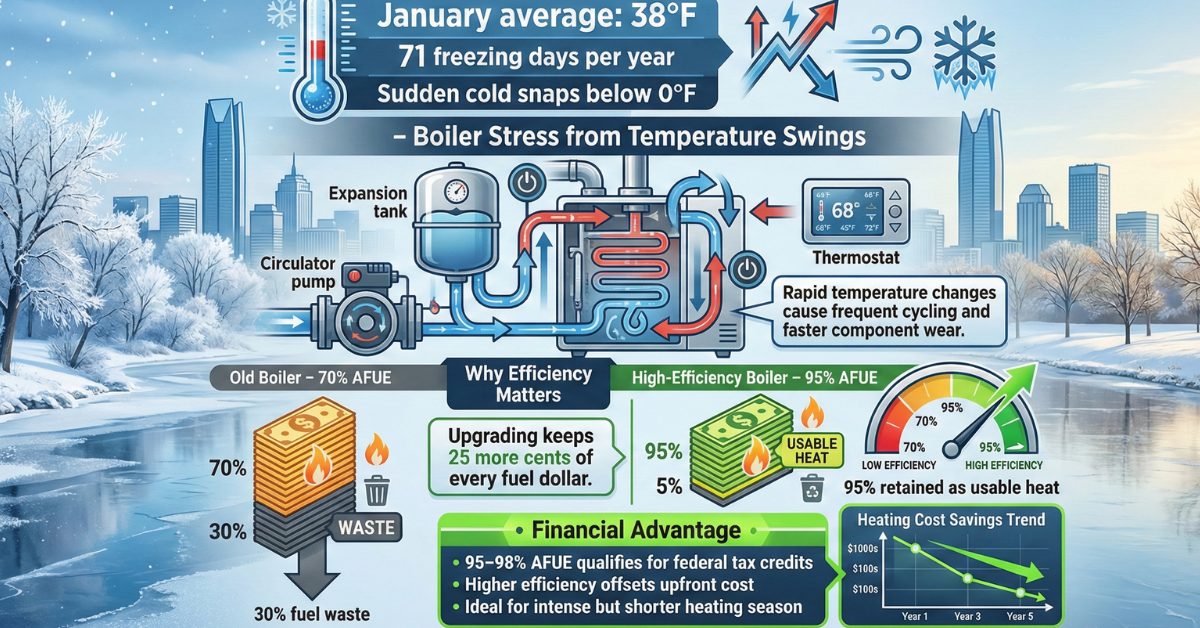
Oklahoma City winters are defined by rapid temperature changes. January’s average temperature hovers around 38 degrees Fahrenheit, but cold snaps can drive the thermometer well below zero. The city averages about 71 days per year where temperatures reach freezing.
These dramatic swings place unique stress on boiler systems. Your boiler may run at full capacity one day and barely be needed the next. That constant cycling accelerates wear on components like the circulator pump, expansion tank, and thermostat.
Why Efficiency Matters More in Oklahoma
Because Oklahoma City’s heating season is shorter but more intense than northern states, every dollar of efficiency counts. A boiler operating at 70% AFUE during a harsh cold snap wastes nearly a third of every fuel dollar. Upgrading to a 95% AFUE model means keeping 25 more cents of every dollar as usable heat.
According to boiler replacement pricing data from This Old House, high-efficiency boilers with 95% to 98% AFUE ratings qualify for federal tax credits that help offset the higher upfront cost.
Can Tax Credits and Rebates Offset Boiler Replacement Cost?
If you’re leaning toward replacement, federal incentives can significantly reduce your out-of-pocket expense.
Federal Energy Efficient Home Improvement Tax Credit
The Inflation Reduction Act provides a 30% federal tax credit on qualifying high-efficiency boiler installations. ENERGY STAR certified gas boilers with an AFUE rating of 95% or higher qualify, with a maximum credit of $600 per year through 2032, according to federal tax credits for high-efficiency boilers from ENERGY STAR. Save your purchase invoice and installation documentation, then file IRS Form 5695 with your tax return.
Finding Local Incentives in Oklahoma
Beyond the federal credit, many Oklahoma utility providers offer additional rebates for high-efficiency HVAC installations. Check with OG&E and Oklahoma Natural Gas for current programs. Pairing a federal tax credit with a local utility rebate can knock $800 to $1,200 or more off your total replacement cost.
Make the Right Call for Your Oklahoma City Home
The repair-or-replace decision comes down to three factors: cost, age, and safety. Use the 50% rule to compare your repair quote against a new system. Factor in your boiler’s age using the multiplication formula. And never ignore safety warning signs like strange noises, leaks, or discolored flames.
If your boiler is under 10 years old and the repair is minor, fixing it is usually the right call. If it’s over 15 years old, losing efficiency, or racking up frequent repair bills, a high-efficiency replacement will save you more over time.
The AAdvantage team provides honest, no-pressure boiler assessments for Oklahoma City homeowners. Whether a repair or replacement makes sense, we’ll walk you through every option. Explore our HVAC maintenance plans in Oklahoma to keep your system running strong, or contact us to schedule a boiler repair service in Oklahoma City today.