


Single-stage Vs Two-stage Vs Variable Speed Furnace
The best furnace type for most homeowners is a two-stage furnace, which costs $8,000 to $12,000 installed, operates at 65% or 100% capacity, and delivers quieter, more even heating than single-stage models without the $13,000+ price tag of variable speed systems. Single-stage furnaces ($5,500 to $7,500) work well for smaller single-story homes on a budget, while variable speed furnaces ($13,000 to $14,000) offer the highest comfort, lowest noise (as quiet as 30 dBA), and greatest long-term energy savings for larger or multi-story homes.
Key Takeaways
- Single-stage furnaces run at 100% capacity or off. Best for small, single-story homes. Cost: $5,500 to $7,500 installed. Lowest upfront price but highest energy use and most temperature swings.
- Two-stage furnaces run at 65% capacity most of the time, switching to 100% only on the coldest days. Cost: $8,000 to $12,000. The best value for most Oklahoma City and Portland homeowners.
- Variable speed furnaces adjust output from 25% to 100% in small increments. Cost: $13,000 to $14,000. Best comfort, quietest operation, and highest long-term savings for larger homes.
- New federal standards taking effect in late 2028 will require a minimum 95% AFUE for all residential gas furnaces, making high-efficiency two-stage and variable speed models future-proof investments.
- A properly sized and installed furnace matters more than brand. Even a top-tier variable speed unit underperforms when incorrectly sized or installed by an unqualified contractor.
Single-Stage vs Two-Stage vs Variable Speed: Quick Comparison
| Feature | Single-Stage | Two-Stage | Variable Speed |
| Capacity Settings | 100% only (on/off) | 65% low / 100% high | 25% to 100% (incremental) |
| Installed Cost | $5,500 – $7,500 | $8,000 – $12,000 | $13,000 – $14,000 |
| AFUE Range | 80% – 95% | 90% – 97% | 95% – 98.5% |
| Temperature Consistency | Noticeable swings | Steady, even heating | Precise within 0.5°F |
| Noise Level | Loudest (full blast every cycle) | Quieter (low stage most of the time) | Quietest (as low as 30 dBA) |
| Air Filtration | Basic (short run times) | Better (longer cycles) | Best (near-continuous airflow) |
| Humidity Control | Limited | Improved | Superior |
| Best For | Small, single-story homes | Most homes (best value) | Large, multi-story homes |
| Zoned HVAC Compatible | No | Yes | Yes |
Sources: HVAC.com, Mattioni, Trane
How Does a Single-Stage Furnace Work?
A single-stage furnace is the simplest type of home heating system. It has one operating mode: full power. When the thermostat calls for heat, the furnace fires at 100% capacity and stays there until the target temperature is reached. Then it shuts off completely and waits for the next call.
On-or-Off Heating and Its Tradeoffs
According to Trane, single-stage systems cycle on and off frequently because they can only operate at full capacity or not at all. That frequent cycling creates temperature swings throughout the home, particularly in multi-story layouts where heat doesn’t distribute evenly. Rooms near vents warm up fast while spaces farther from the unit stay cooler.
The constant full-blast cycling also drives up energy costs. Single-stage furnaces use the most electricity and gas per heating season compared to two-stage and variable speed models because every startup demands maximum fuel input.
Who Should Choose a Single-Stage Furnace?
Single-stage furnaces are a smart pick for homeowners with smaller, single-story homes (under 1,200 square feet) who want the lowest upfront cost. They’re mechanically simple with fewer components, which means less that can break down. If your budget is under $7,500 for installation or you plan to sell within a few years, a single-stage unit delivers reliable heating without a major investment.
If you’re also deciding between fuel types, our guide to comparing electric and gas furnace options breaks down cost and efficiency differences for Oklahoma and Portland homeowners.
What Makes a Two-Stage Furnace Different?
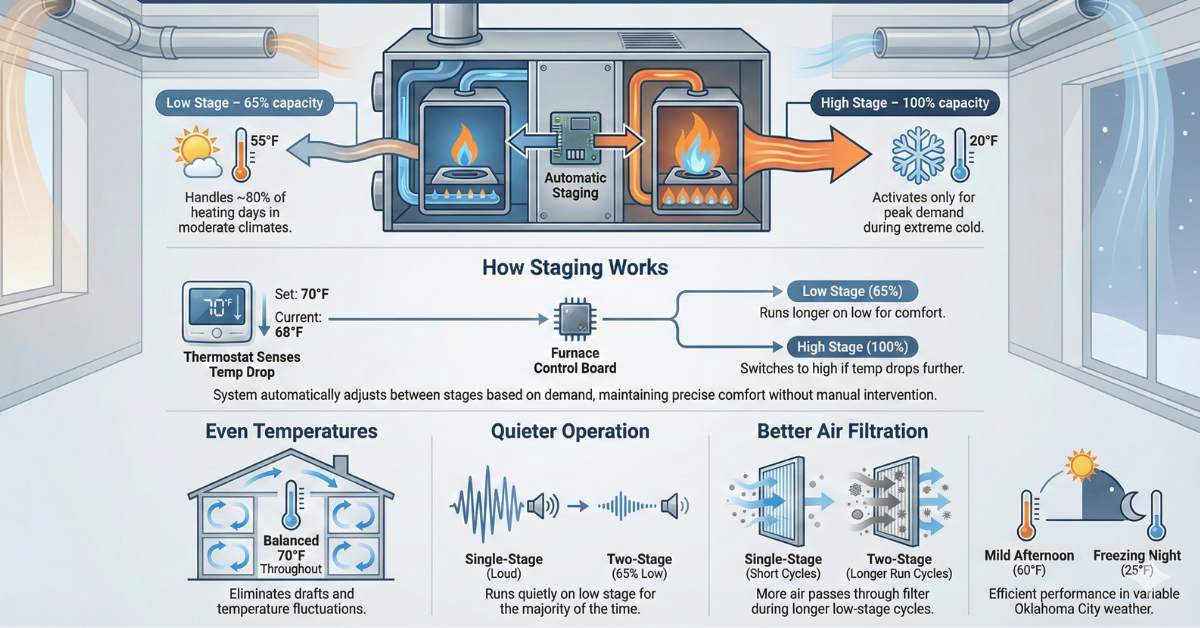
A two-stage furnace operates at two distinct capacity levels: a low stage (typically around 65% capacity) and a high stage (100% capacity). The system automatically selects the right stage based on heating demand, running on low most of the time and switching to high only during the coldest conditions.
How the Low and High Settings Work Together
According to HVAC industry experts at Mattioni Plumbing, Heating & Cooling, two-stage furnaces run for longer periods at lower output, resulting in more thoroughly mixed air throughout the home. This eliminates cold and warm spots and keeps the entire living space at a uniform temperature. The low stage handles roughly 80% of heating days in moderate climates like Oklahoma and Portland, while the high stage activates only during extreme cold snaps.
The automatic staging also means you don’t have to manage anything manually. The furnace senses when the low stage isn’t keeping up and shifts to high on its own, usually within a few minutes.
Why Two-Stage Is the Sweet Spot for Most Homeowners
Two-stage furnaces offer three distinct advantages over single-stage models:
- More even temperatures. Longer, gentler run cycles distribute heat more completely through your ductwork, reducing the hot-and-cold-spot problem.
- Quieter operation. At 65% capacity, the blower runs softer, eliminating the sudden blast of air you hear with single-stage units.
- Better air filtration. Longer run times mean air passes through the furnace filter more often per hour, trapping more dust, allergens, and contaminants.
For Oklahoma City homeowners dealing with temperature swings from 50°F afternoons to sub-freezing nights, a two-stage furnace handles both extremes efficiently. Portland residents benefit from the consistent low-stage heating during their damp, mild winters.
Why Is a Variable Speed Furnace the Most Advanced Option?
A variable speed furnace uses an electronically commutated motor (ECM) and modulating gas valve to adjust heat output in small increments, running anywhere from 25% to 100% capacity. Unlike single-stage (one speed) or two-stage (two speeds), a variable speed system makes continuous micro-adjustments to match your home’s exact heating demand at any given moment.
Precision Temperature Control in Real Time
According to Trane’s engineering team, variable speed systems reach and maintain your desired temperature within half a degree of the thermostat setting. The system runs almost continuously at low speeds, ramping up only when needed and dialing back as soon as the demand is met.
As experts at American Standard explain, “A high-efficiency furnace makes sense in regions with colder climates and higher utility costs. These furnaces use less gas to produce the same amount of heat, which translates to lower energy bills for homeowners.” When that high efficiency is paired with variable speed modulation, the energy savings compound year after year.
Noise, Air Quality, and Humidity Benefits
Variable speed furnaces deliver three premium advantages that justify their higher price point:
- Whisper-quiet operation. Because the system runs at low capacity most of the time, noise levels drop to as low as 30 dBA, roughly the volume of a whisper. No more jarring startup blasts.
- Superior air filtration. Near-continuous airflow keeps your furnace filter working around the clock, trapping dust, allergens, mold spores, and other contaminants far more effectively than systems that cycle on and off.
- Better humidity control. Variable speed systems maintain consistent moisture levels throughout your home, preventing the dry-air problems common with single-stage furnaces in Oklahoma winters and managing excess humidity during Portland’s damp cold seasons.
For a broader look at how this technology works in cooling mode, check out our article on why you need a variable speed heat pump.
How Much Does Each Furnace Type Cost?
The installed cost of a furnace depends on the type, efficiency rating (AFUE), home size, and installation complexity. According to HVAC.com’s 2025-2026 buying guide, a new furnace with professional installation typically costs between $3,000 and $8,000. Data from Mattioni’s cost analysis provides a more specific breakdown by type:
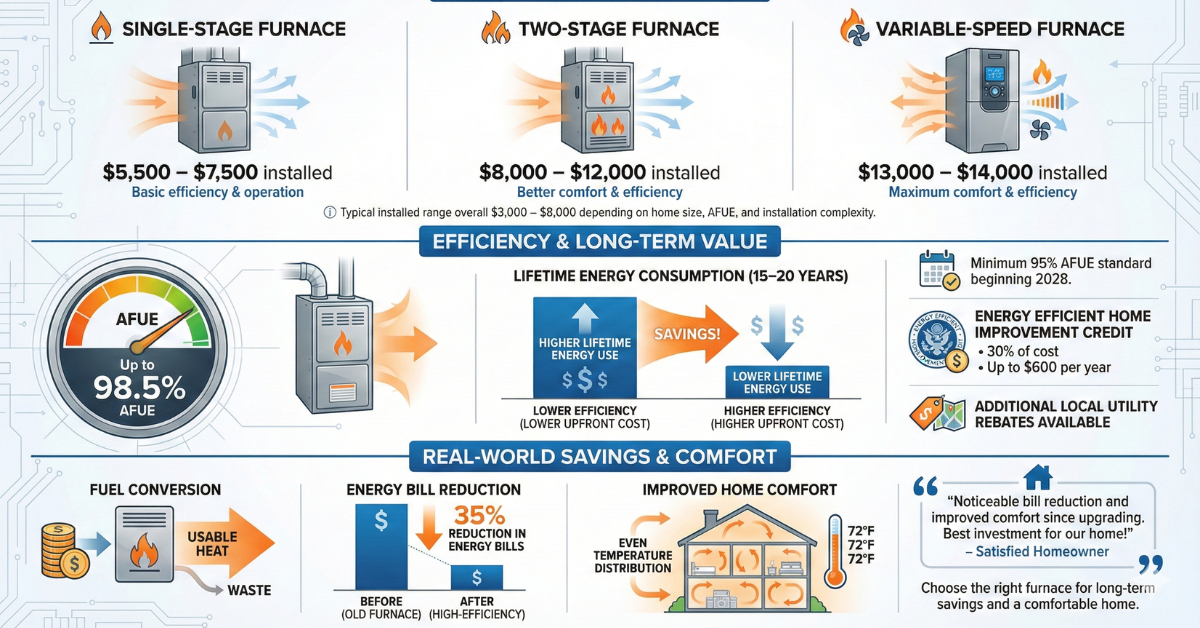
- Single-stage furnaces: $5,500 to $7,500 installed
- Two-stage furnaces: $8,000 to $12,000 installed
- Variable speed furnaces: $13,000 to $14,000 installed
Long-Term Savings and Federal Tax Credits
While variable speed and two-stage furnaces cost more upfront, they consume less energy over their 15 to 20 year lifespan. The U.S. Department of Energy confirms that modern high-efficiency furnaces can achieve up to 98.5% AFUE (Annual Fuel Utilization Efficiency), meaning nearly every dollar you spend on fuel converts to usable heat.
U.S. Secretary of Energy Jennifer M. Granholm has emphasized the importance of efficiency upgrades, stating that updated furnace standards will “slash household utility costs by $1.5 billion annually and significantly reduce greenhouse gas emissions.” New federal efficiency standards taking effect in late 2028 will require a minimum 95% AFUE for all residential gas furnaces.
Homeowners can also claim the Energy Efficient Home Improvement Credit (Section 25C), which covers 30% of the cost of a qualifying high-efficiency gas furnace, up to $600 per year. Combined with local utility rebates in Oklahoma or Oregon, the effective price gap between furnace types narrows considerably.
Real-World Savings in Oklahoma
One Oklahoma City family working with AAdvantage upgraded from a 15-year-old system to a high-efficiency unit and saw a 35% reduction in their energy costs. As they shared, “Our energy bills dropped noticeably, and the house stays more comfortable throughout the day.” That kind of measurable result demonstrates how the higher upfront investment pays back within a few years. To make sure you’re starting with the right foundation, use our guide on choosing the right furnace size for your home.
Which Furnace Type Is Right for Your Home?
The right furnace depends on three factors: your home’s size and layout, your local climate, and how much you’re willing to invest upfront versus save over time. There is no single “best” furnace for every homeowner.
Matching Furnace Type to Home Size
HVAC experts at Fire & Ice Heating and Air Conditioning point out that cold spots in your home won’t be solved by efficiency alone. A two-stage or variable speed furnace circulates air more evenly and reduces dry heat. Here’s a quick guide based on home size:
- Under 1,200 sq ft, single story: A single-stage furnace handles the job efficiently at the lowest cost.
- 1,200 to 2,500 sq ft, or multi-story: A two-stage furnace provides the best balance of comfort, efficiency, and value.
- Over 2,500 sq ft, multi-story, or zoned HVAC: A variable speed furnace delivers precision temperature control and works with zoned heating setups for maximum efficiency.
Our guide to upflow and downflow furnace configurations also helps you understand how installation orientation impacts heating performance in your specific home layout.
Climate Recommendations for Oklahoma and Portland
Oklahoma’s climate demands a furnace that handles both mild 50°F fall days and freezing winter nights that can drop below 0°F during cold snaps. A two-stage furnace is the ideal middle ground for most Oklahoma City homes, running efficiently on its low stage most of the time with high-stage power ready when temperatures plunge.
Portland’s winters are milder but consistently damp, with average winter lows around 35°F to 40°F. Variable speed furnaces excel in this climate because their continuous low-speed operation provides superior humidity control and steady warmth without the energy waste of constant cycling. That said, Portland homeowners in smaller homes often find a two-stage system meets their needs at a lower cost.
Why Installation Quality Matters as Much as Equipment
Even the best furnace underperforms when improperly sized or installed. A qualified HVAC contractor should perform a Manual J load calculation to determine the exact capacity your home needs, verify ductwork compatibility, and configure the thermostat to match your furnace’s staging capabilities. Skipping these steps can leave you with uneven heating, wasted energy, and a system that wears out faster than it should.
If your current furnace is showing signs of trouble, our furnace troubleshooting guide can help you determine whether a repair or full replacement makes more sense.
Ready to Choose Your Next Furnace?
Whether you’re leaning toward a budget-friendly single-stage, the balanced performance of a two-stage, or the premium comfort of a variable speed furnace, the team at AAdvantage Heating & Air Conditioning is here to help you make the right call. We serve homeowners across Oklahoma City and Portland with honest advice, proper sizing, and professional installation. Reach out to AAdvantage today and let’s find the perfect furnace for your home.