Skip to content




Blown-In vs Spray Foam Insulation Cost Comparison
Blown-in insulation costs Oklahoma City homeowners between $1.00 and $1.80 per square foot installed, while spray foam ranges from $1.70 to $5.00 per square foot depending on whether you choose open-cell or closed-cell. For a typical 1,200-square-foot OKC attic, that translates to roughly $1,200 to $2,160 for blown-in versus $2,040 to $6,000 for spray foam.
The right choice depends on your budget, your home’s age, and how long you plan to stay.
Key Takeaways
- Blown-in insulation is the budget-friendly option at $1.00-$1.80/sq ft, ideal for attics and retrofitting older OKC homes
- Spray foam insulation costs $1.70-$5.00/sq ft but delivers superior air sealing and a longer lifespan of 50+ years
- R-value per inch favors spray foam: closed-cell offers R-5.6 to R-8.0 compared to blown-in’s R-2.2 to R-3.8
- Oklahoma City sits in Climate Zones 3-4, requiring attic insulation of R-30 to R-49 per Oklahoma’s residential building energy code
- Proper insulation combined with air sealing can reduce heating and cooling costs by an average of 15%, according to research from the EPA and ENERGY STAR
What Is Blown-In Insulation and How Does It Work?
Blown-in insulation is a loose-fill material installed using a specialized blower machine that distributes the product into attics, wall cavities, and other hard-to-reach spaces. It conforms to irregular shapes and fills gaps that rigid insulation types often miss, making it a popular choice for retrofitting existing Oklahoma City homes without tearing into walls.
Types of Blown-In Insulation
The two most common blown-in materials are cellulose and fiberglass, and each performs differently in OKC’s demanding climate.
Cellulose is made from roughly 85% recycled paper products treated with fire retardants like boric acid. It offers an R-value of approximately 3.2 to 3.8 per inch and provides decent resistance to air movement through the material. According to the U.S. Department of Energy’s insulation guidelines, the effectiveness of any insulation depends heavily on proper installation and how it interacts with surrounding building materials. As Dr. Joseph Lstiburek wrote in ASHRAE Journal, “I like all insulations. I think they are all good, but they all have limitations.” The key is matching the right product to your home’s specific needs and ensuring it’s installed correctly.
Fiberglass loose-fill delivers an R-value of about 2.2 to 2.7 per inch. It resists moisture better than cellulose and won’t absorb water, though it does allow more air to pass through compared to denser materials.
Best Applications for OKC Homes
Blown-in insulation works particularly well in these situations:
- Attic floors where large, open areas need coverage quickly
- Existing wall cavities in older homes that lack adequate insulation
- Retrofit projects where minimal disruption is a priority
AAdvantage Heating & Air Conditioning provides professional blown-in insulation services in Oklahoma City for both residential and commercial properties, ensuring proper density and coverage.
What Is Spray Foam Insulation and Why Do OKC Homeowners Choose It?
Spray foam insulation is a two-part chemical mixture applied as a liquid that expands and hardens to fill every crack and crevice in your home’s building envelope. Unlike blown-in materials, spray foam bonds directly to surfaces and creates a continuous, seamless barrier against air and moisture movement. You can learn more about the benefits of spray foam insulation for OKC homes and how it compares for Oklahoma’s specific climate challenges.
Open-Cell vs Closed-Cell Spray Foam
These two types serve different purposes and come at different price points.
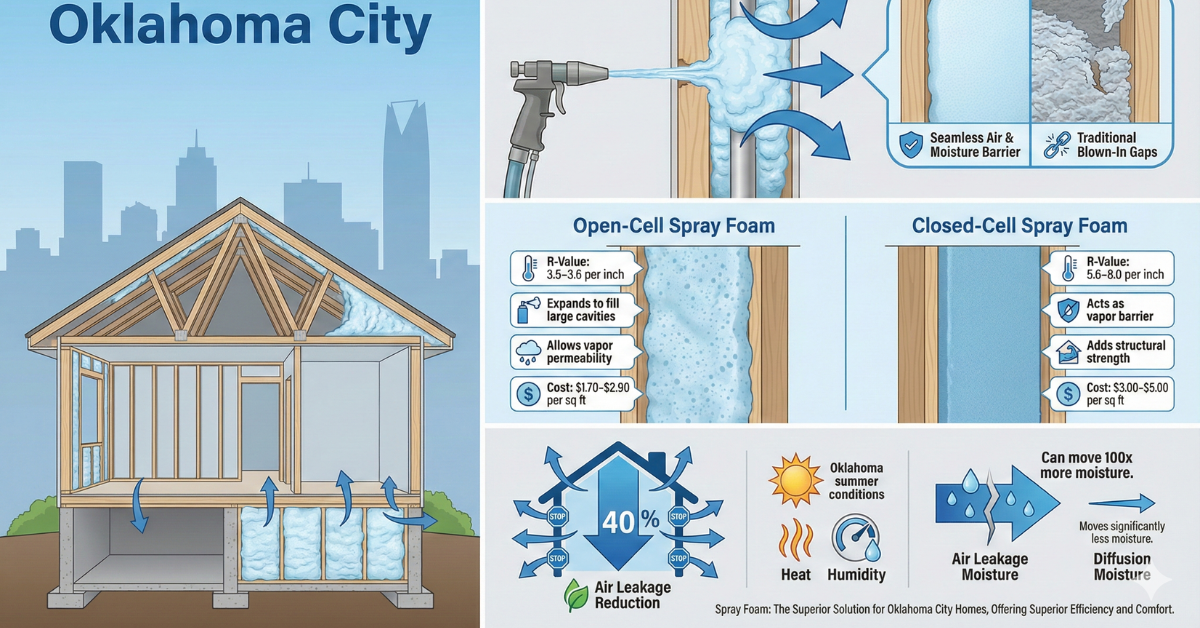
Open-cell spray foam is softer and more flexible, with an R-value of 3.5 to 3.6 per inch. It expands significantly during application, making it effective for filling large cavities. Open-cell foam allows some moisture vapor to pass through, which can be beneficial in certain wall assemblies. It typically costs $1.70 to $2.90 per square foot installed, according to current insulation pricing trends.
Closed-cell spray foam is denser and more rigid, delivering an R-value of 5.6 to 8.0 per inch. It acts as both an insulator and a vapor barrier, blocking moisture intrusion in addition to air leakage. Closed-cell foam costs $3.00 to $5.00 per square foot but provides structural rigidity and superior performance in humid conditions.
Air Sealing and Moisture Resistance Benefits
One of the primary reasons OKC homeowners invest in spray foam is its air-sealing capability. The U.S. Department of Energy estimates that air leakage accounts for up to 40% of a home’s total heating and cooling energy consumption. Spray foam fills every gap and crack, effectively eliminating this energy drain.
Building scientist Joe Lstiburek, Ph.D., P.Eng., principal of Building Science Corporation and an ASHRAE Fellow, has emphasized that moisture transported through air leaks can be roughly 100 times greater than moisture moving through material diffusion alone. In Oklahoma City, where summer humidity combines with intense heat, that makes air sealing just as critical as R-value when choosing insulation for long-term home performance.
How Much Does Blown-In vs Spray Foam Insulation Cost in Oklahoma City?
Cost is typically the first factor OKC homeowners consider, and the price difference between these two options is significant. Here’s a detailed breakdown based on national spray foam insulation cost data and regional averages.
Blown-In Insulation Cost Breakdown
| Material | Cost Per Sq Ft (Installed) | 1,200 Sq Ft Attic Estimate |
| Cellulose | $1.10 – $1.80 | $1,320 – $2,160 |
| Fiberglass | $1.00 – $1.70 | $1,200 – $2,040 |
Blown-in cellulose averages $1.10 to $1.80 per square foot installed in 2026, while blown-in fiberglass runs $1.00 to $1.70 per square foot. Prices vary based on the depth needed to achieve your target R-value, the accessibility of the space, and whether existing insulation needs removal, which adds $1.50 to $2.00 per square foot.
Spray Foam Insulation Cost Breakdown
| Foam Type | Cost Per Sq Ft (Installed) | 1,200 Sq Ft Attic Estimate |
| Open-Cell | $1.70 – $2.90 | $2,040 – $3,480 |
| Closed-Cell | $3.00 – $5.00 | $3,600 – $6,000 |
The average professional spray foam installation project costs between $1,453 and $4,332 nationally, with whole-home projects reaching $8,000 or more. Closed-cell spray foam costs roughly 60-80% more than open-cell but delivers substantially higher R-value per inch and built-in moisture protection.
For most Oklahoma City attic projects, expect the total investment to fall between $2,000 and $6,000 for spray foam versus $1,200 and $2,200 for blown-in.
Which Insulation Delivers Better R-Value Per Dollar in Oklahoma’s Climate Zone?
Oklahoma City falls within IECC Climate Zones 3 and 4, which means your home needs attic insulation rated between R-30 and R-49 to meet energy code requirements. Understanding how each insulation type achieves those targets helps you compare true value, not just sticker price.
R-Value Comparison Table
| Insulation Type | R-Value Per Inch | Inches Needed for R-38 | Inches Needed for R-49 |
| Blown-In Cellulose | 3.2 – 3.8 | 10 – 12 inches | 13 – 15 inches |
| Blown-In Fiberglass | 2.2 – 2.7 | 14 – 17 inches | 18 – 22 inches |
| Open-Cell Spray Foam | 3.5 – 3.6 | 10.5 – 11 inches | 13.5 – 14 inches |
| Closed-Cell Spray Foam | 5.6 – 8.0 | 5 – 7 inches | 6 – 9 inches |
As insulation performance comparisons show, closed-cell spray foam achieves the same R-value in roughly half the thickness of blown-in materials. That matters when you have limited space in wall cavities or between rafters.
Real-World Performance vs Lab Ratings
There’s an important distinction between lab-tested R-values and how insulation actually performs in your home. Traditional insulation R-values are measured under ideal laboratory conditions. Jonathan Lang, Manager of Training and Certifications for Knauf Insulation and a BPI Certified Building Analyst, has noted that many builders focus on sealing areas that don’t need attention while neglecting the spots that matter most. In real-world applications, gaps around batts, settled blown-in material, and thermal bridging through studs and joists can dramatically reduce effective performance.
Spray foam eliminates many of these issues because it expands to fill every crack and creates a continuous thermal barrier. For OKC homes dealing with extreme temperature swings from triple-digit summers to below-freezing winters, that consistent performance makes a measurable difference on your energy bills.
How Long Does Each Insulation Type Last?
Lifespan is where the long-term cost equation shifts significantly. The insulation you choose today will affect your home’s comfort and energy bills for decades.
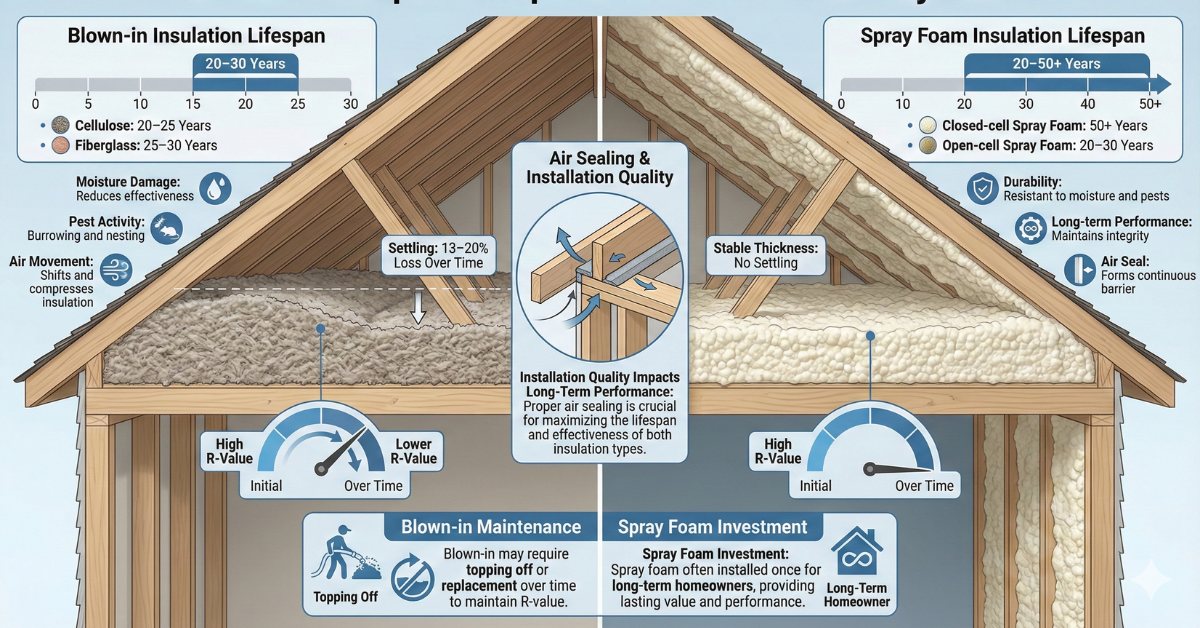
Blown-In Insulation Lifespan: 20-30 Years
Blown-in insulation generally lasts 20 to 30 years, depending on the material and environmental conditions. Cellulose tends to perform well for 20 to 25 years, while fiberglass can maintain its effectiveness for 25 to 30 years.
The biggest challenge with blown-in cellulose is settling. Cellulose has settling rates ranging from 13 to 20% after installation. This settling continues over weeks, months, and years, gradually creating gaps that reduce your insulation’s effective R-value. Professional installers compensate by adding extra material upfront, but some settling is inevitable.
Other factors that shorten blown-in insulation lifespan include:
- Moisture exposure from roof leaks or condensation, which causes cellulose to clump and lose effectiveness
- Pest damage from rodents nesting in and compressing the material
- Air movement that shifts and scatters lightweight insulation over time
Spray Foam Insulation Lifespan: 50+ Years
Professionally installed spray foam insulation can last 50 years or more for closed-cell applications and 20 to 30 years for open-cell. Unlike blown-in materials, spray foam does not settle, shift, or sag over time. It adheres permanently to the surfaces it contacts and maintains its R-value throughout its lifespan.
According to Stacy Fitzgerald-Redd of the Insulation Institute, no insulation product acts as a whole-home air sealer and insulator on its own. Even spray foam cannot seal critical air leakage joints such as top plates, where other materials like foam gaskets or tapes are needed. However, Building Science Corporation’s Thermal Metric Report confirms that all insulation types perform essentially the same when properly air sealed and installed, making installation quality a key factor in long-term durability.
For OKC homeowners planning to stay in their homes long-term, this durability difference means spray foam may only need to be installed once, while blown-in insulation could require replacement or topping off within your ownership period.
What Are the Total Long-Term Savings for OKC Homeowners?
The true cost of insulation isn’t what you pay upfront. It’s the combination of installation cost, energy savings, and replacement expenses over the life of the product. Oklahoma City’s extreme climate makes this calculation especially important.
Energy Savings Potential
The EPA estimates that homeowners can save an average of 15% on heating and cooling costs by air sealing their homes and adding insulation in attics, floors over crawl spaces, and accessible basement areas. For poorly insulated homes, the savings can reach 30-50% on energy costs, according to industry data from Rogers Insulation Specialists.
In Oklahoma City, where summer AC bills routinely reach $250 to $400 per month for under-insulated homes and winter heating accounts for nearly 40% of energy usage, those percentages translate to real money. A 15% reduction on $3,000 in annual heating and cooling costs saves $450 per year. Over 20 years, that’s $9,000 in savings before accounting for rising utility rates.
One Oklahoma City family working with AAdvantage saw their summer cooling costs drop by 35% after upgrading their home’s energy efficiency, demonstrating that the right improvements deliver meaningful financial results.
ROI Comparison
| Factor | Blown-In | Spray Foam (Closed-Cell) |
| Typical Attic Cost (1,200 sq ft) | $1,200 – $2,160 | $3,600 – $6,000 |
| Estimated Annual Energy Savings | $300 – $450 | $450 – $675 |
| Payback Period | 3 – 7 years | 5 – 13 years |
| Expected Lifespan | 20 – 30 years | 50+ years |
| Lifetime Replacement Cost | $1,200 – $2,160 (one replacement) | $0 (no replacement needed) |
When you factor in the cost of replacing blown-in insulation at the 25-year mark plus the higher ongoing energy savings from spray foam’s superior air sealing, the total cost of ownership over 50 years is often comparable between the two options.
What About Tax Credits and Incentives?
The federal Section 25C Energy Efficient Home Improvement Credit, which offered 30% back on qualifying insulation materials up to $1,200 per year, expired on December 31, 2025 for new installations, as confirmed by the IRS Energy Efficient Home Improvement Credit guidelines. However, Oklahoma homeowners should check with their local utility providers and the Oklahoma state energy office for current rebate programs and incentives that may help offset insulation costs in 2026 and beyond.
Understanding how efficiency ratings affect your Oklahoma energy bills can also help you maximize the return on your insulation investment by pairing it with an efficient HVAC system.
Which Option Is Right for Your Oklahoma City Home?
Both blown-in and spray foam insulation serve OKC homeowners well, but your specific situation determines which delivers the best value.
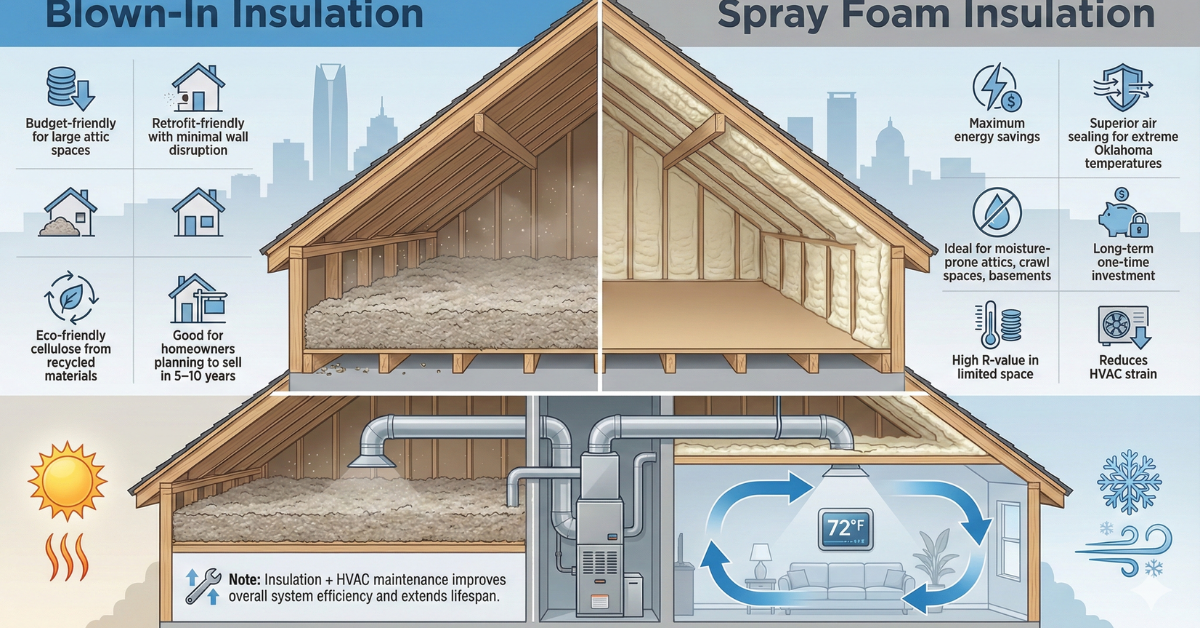
Choose Blown-In Insulation If:
- You have a limited budget and need to insulate a large attic space affordably
- Your home is a retrofit project where wall cavities need filling with minimal disruption
- You’re looking for an eco-friendly option, especially cellulose made from recycled materials
- You plan to sell the home within the next 5-10 years and need a cost-effective improvement
Choose Spray Foam Insulation If:
- You want maximum energy savings and the best possible air sealing for Oklahoma’s extreme temperatures
- Your home has moisture concerns in the attic, crawl space, or basement
- You’re staying in the home long-term and want a one-time insulation investment
- You need high R-value in limited space, such as cathedral ceilings or thin wall cavities
- You want to reduce HVAC strain and extend the life of your heating and cooling equipment
Regardless of which option you choose, keeping up with regular HVAC maintenance ensures your system works efficiently alongside your new insulation. And as summer approaches, preparing your HVAC system for Oklahoma’s brutal summers becomes even more effective when your home is properly insulated.
Your Next Step: Get a Professional Insulation Assessment
The best insulation choice for your home depends on factors that are unique to your property, including your home’s age, existing insulation condition, air leakage patterns, and your budget. A professional evaluation takes the guesswork out of the decision.
AAdvantage Heating & Air Conditioning serves homeowners throughout Oklahoma City and the surrounding metro area with honest assessments, expert installation, and straightforward pricing. Whether you’re leaning toward blown-in or spray foam, our team can help you find the right solution for your home and your budget. Reach out to schedule your insulation evaluation today.