Skip to content



The best furnaces for Oklahoma winters in 2026 are Carrier, Trane, Lennox, and Goodman. These brands offer 90% to 99% AFUE efficiency ratings, 10-year or longer warranties, and two-stage or variable-speed technology that handles Oklahoma’s rapid temperature swings, where January averages 38°F but can plunge to -17°F during cold snaps.
Oklahoma homeowners should look for a gas furnace with at least 95% AFUE to future-proof against new federal standards taking effect in December 2028.
Key Takeaways
- Best overall: Carrier Infinity series (up to 98.5% AFUE, 10-year parts warranty, smart home integration)
- Best efficiency: Lennox SLP99V (99% AFUE, the highest-rated gas furnace available)
- Best reliability: Trane/American Standard (rated #1 for predicted reliability by Consumer Reports)
- Best value: Goodman/Amana (up to 98% AFUE with lifetime heat exchanger warranty)
- Oklahoma minimum recommendation: 90% AFUE (ENERGY STAR Southern Region requirement)
- Typical cost range: $2,100 to $10,000 installed, with federal tax credits up to $2,000
What Makes Oklahoma Winters Unique for Furnace Selection?
Oklahoma’s humid subtropical climate creates heating challenges that most other states don’t face. The state sits at the collision point between warm Gulf of Mexico air and cold northern Plains air masses, producing some of the most rapid temperature changes in the country. Understanding these conditions is essential for choosing a furnace that won’t leave you shivering during a cold snap or wasting energy on mild days.
Wild Temperature Swings and Cold Snaps
Oklahoma City’s average January temperature sits around 38°F, but the city has recorded winter lows as extreme as -17°F. During the February 2021 winter storm, wind chills dropped well below zero across the entire state, pushing heating systems to their absolute limits.
According to the Oklahoma Climatological Survey, “Winters are shorter and less severe than those of the more northern Plains states. Periods of extreme cold are infrequent, and those lasting more than a few days are rare.” However, when those cold snaps do arrive, they hit fast. It’s common for temperatures to drop 30 to 40 degrees in a single day when a cold front pushes through.
Why This Matters for Your Furnace Choice
These conditions mean your furnace needs to handle two very different jobs:
- Mild days (40°F to 55°F): Furnace should run at low capacity to maintain comfort without constant on-off cycling
- Cold snaps (below 20°F): Furnace needs full heating power to keep up with rapid heat loss
- Transition days: System should adjust smoothly as temperatures shift throughout the day
A single-stage furnace that only runs at 100% capacity will waste energy on mild days and may still struggle during extreme cold. That’s why HVAC professionals in Oklahoma consistently recommend two-stage or variable-speed systems for our climate. You can explore what fits Oklahoma homes best in our detailed fuel-type comparison.
What Are the Best Furnaces for Oklahoma Winters for Homes in 2026?
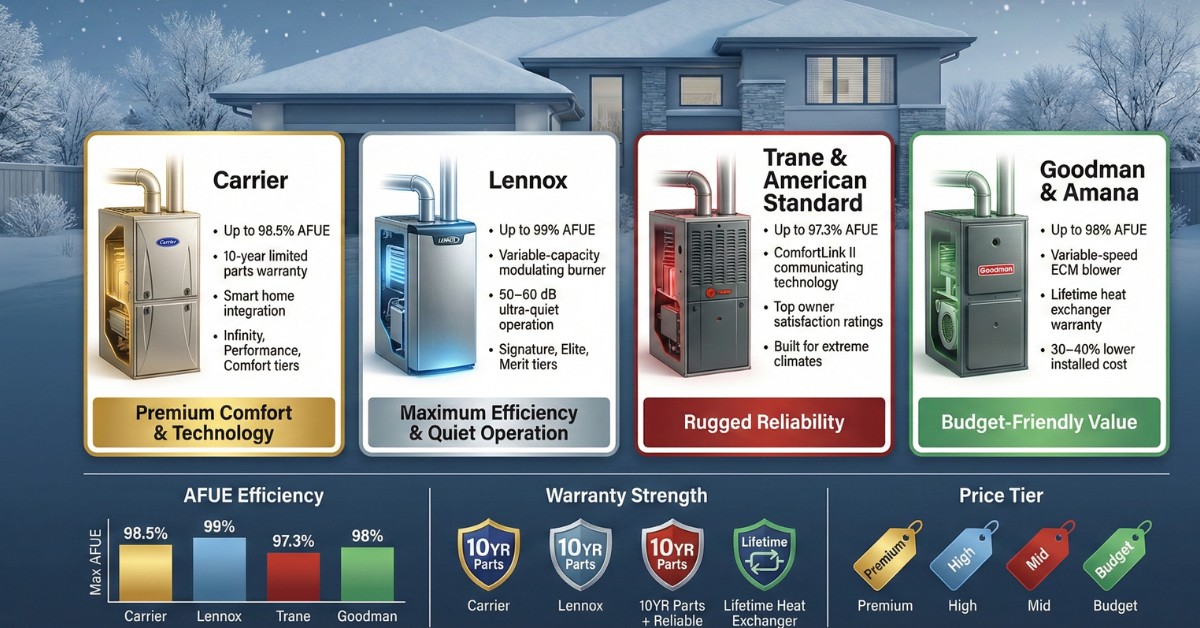
Four furnace brands consistently stand out for Oklahoma homeowners based on efficiency ratings, warranty coverage, reliability data, and real-world performance. Each brand serves a different type of homeowner, from premium comfort seekers to budget-conscious families.
Carrier
Carrier has been a cornerstone of the HVAC industry since Willis Carrier invented modern air conditioning in 1902. Their Infinity series furnaces reach up to 98.5% AFUE, converting nearly every dollar of gas into usable heat.
According to HVAC industry analysts at MR. HVAC, who have installed and serviced furnaces for over 25 years, Carrier is “positioned as a premium brand” that “commands higher prices, but the return comes through top-tier efficiency, comfort, and durability.”
Key specs:
- Up to 98.5% AFUE (Infinity series)
- 10-year limited parts warranty
- Smart home integration via Infinity System Control
- Factory-trained dealer installation network
- Three product tiers: Infinity, Performance, and Comfort
Best for: Oklahoma homeowners who want premium comfort, smart technology, and long-term reliability.
Lennox
Lennox has been manufacturing heating equipment since 1895 and produces some of the most efficient furnaces available today. Their SLP99V model achieves an industry-leading 99% AFUE rating, which means virtually zero fuel waste.
As MR. HVAC explains, Lennox’s “premium models use variable-capacity modulating burners that fine-tune heat output for precise temperature control and lower energy use, and many operate in the 50-60 dB range, among the quietest in the industry.”
Key specs:
- Up to 99% AFUE (SLP99V)
- Variable-capacity modulating burner
- 50-60 dB operating range (among the quietest available)
- Three product tiers: Signature, Elite, and Merit
- Note: Parts can be more expensive and harder to source
Best for: Homeowners who prioritize maximum efficiency and whisper-quiet operation.
Trane and American Standard
Trane and American Standard are sister brands manufactured by the same parent company, delivering identical engineering under different brand names. According to reliability data from Consumer Reports, which surveyed more than 500 HVAC specialists, “Trane was the only one to earn top marks for owner satisfaction” among the most reliable brands tested.
Key specs:
- Up to 97.3% AFUE (XC95m)
- Modulating heat with ComfortLink II communicating technology
- Excellent predicted reliability and owner satisfaction ratings
- Heavy-duty construction designed for extreme climates
- American Standard offers the same quality at a more competitive price
Best for: Oklahoma homeowners who value rugged durability and long-lasting performance in extreme weather.
Goodman and Amana
For budget-conscious homeowners, Goodman and Amana deliver strong performance without the premium price tag. As Bay Area Climate Control notes, Goodman is “a smart choice when you want respectable efficiency and a solid warranty, but need to keep installation costs under tighter control.”
Key specs:
- Up to 98% AFUE (GMVM97)
- Variable-speed ECM blower motor
- Lifetime limited warranty on heat exchanger (Amana)
- One of the strongest warranty packages in the industry
- Typically 30% to 40% lower installed cost than premium brands
Best for: Budget-conscious Oklahoma homeowners who want dependable heating with strong warranty protection.
Brand Comparison Table
| Feature | Carrier | Lennox | Trane | Goodman |
| Max AFUE | 98.5% | 99% | 97.3% | 98% |
| Warranty (Parts) | 10 years | 10 years | 10 years | 10 years |
| Heat Exchanger Warranty | Limited lifetime | 20 years | Limited lifetime | Lifetime (Amana) |
| Variable-Speed Available | Yes | Yes | Yes | Yes |
| Smart Home Integration | Yes | Yes | Yes | Limited |
| Typical Installed Cost | $4,000-$10,000 | $4,500-$12,000 | $4,500-$14,000 | $2,100-$8,200 |
| Best For | Premium comfort | Max efficiency | Durability | Budget value |
How Do AFUE Ratings Affect Your Oklahoma Energy Bills?
AFUE stands for Annual Fuel Utilization Efficiency, and it measures how much of the gas you pay for actually becomes heat in your home. Think of it like gas mileage for your furnace. A 95% AFUE furnace converts 95 cents of every dollar spent on gas into usable heat, while only 5 cents is lost through exhaust.
Oklahoma falls in the Southern Region under federal energy guidelines, which means ENERGY STAR-certified gas furnaces in our area need a minimum of 90% AFUE. However, a higher rating translates directly into lower bills.
AFUE Efficiency Breakdown
| AFUE Rating | Category | Heat per $1 Gas | Annual Waste | Best For |
| 80% | Standard (minimum legal) | $0.80 | $0.20 per dollar | Not recommended for Oklahoma |
| 90% | Mid-efficiency | $0.90 | $0.10 per dollar | Budget installations |
| 95% | High-efficiency | $0.95 | $0.05 per dollar | Most Oklahoma homes |
| 98-99% | Ultra high-efficiency | $0.98-$0.99 | $0.01-$0.02 per dollar | Maximum savings |
If you’re currently running an older 80% AFUE furnace, upgrading to a 95% model reduces heating fuel costs by approximately 15% to 20% each winter. Over a furnace’s typical 15- to 25-year lifespan, those annual savings compound into thousands of dollars.
It’s also important to know that new federal standards finalized in 2023 will require a minimum 95% AFUE for non-weatherized gas furnaces, taking effect in December 2028. Buying a 95%+ AFUE furnace today means you’re already meeting future requirements. You can learn more about how efficiency standards impact your costs in our guide to how efficiency ratings affect Oklahoma bills.
Single-Stage vs. Two-Stage vs. Variable-Speed: Which Is Right for Oklahoma?
The way your furnace delivers heat matters just as much as its efficiency rating. There are three main furnace types, each with different strengths for Oklahoma’s climate. Choosing the right one can improve your comfort, lower your energy costs, and extend your system’s lifespan.
Single-Stage Furnaces
A single-stage furnace has one setting: 100% capacity. Every time your thermostat calls for heat, the burner fires at full blast, whether it’s a mild 45°F evening or a brutal 10°F night.
- Pros: Lowest upfront cost ($2,100 to $4,500 installed), simple and reliable
- Cons: More on-off cycling, noticeable temperature swings (2-4°F), higher energy use
- Oklahoma fit: Acceptable for smaller homes or very tight budgets, but not ideal for our climate swings
Two-Stage Furnaces
Two-stage furnaces operate at two levels, typically 65% to 70% capacity for mild conditions and 100% for extreme cold.
- Pros: Quieter operation, more even temperatures (1-2°F variance), 10-15% lower energy use than single-stage
- Cons: Moderate upfront cost ($3,500 to $7,000 installed)
- Oklahoma fit: The sweet spot for most Oklahoma homeowners. Handles mild weeks efficiently and ramps up during cold snaps
Our guide on two-stage gas furnaces explains how this technology delivers consistent comfort and energy savings.
Variable-Speed Furnaces
Variable-speed furnaces adjust output in small increments to match your home’s exact heating needs at any given moment.
- Pros: Most even temperatures (less than 1°F variance), quietest operation, best efficiency, superior air filtration
- Cons: Highest upfront cost ($5,000 to $12,000 installed)
- Oklahoma fit: Excellent for homeowners who want maximum comfort and are willing to invest for long-term savings
As Bryant’s AFUE rating guide explains, high-efficiency variable-speed systems with 96% to 98% AFUE are “ideal for homeowners in colder regions who want to future-proof their energy bills.”
Furnace Type Comparison
| Feature | Single-Stage | Two-Stage | Variable-Speed |
| Capacity Levels | 1 (100%) | 2 (65-70% and 100%) | Infinite (adjusts in increments) |
| Temperature Variance | 2-4°F | 1-2°F | Less than 1°F |
| Noise Level | Loudest | Moderate | Quietest |
| Energy Efficiency | Baseline | 10-15% better | 15-25% better |
| Installed Cost | $2,100-$4,500 | $3,500-$7,000 | $5,000-$12,000 |
| Oklahoma Recommendation | Budget only | Best value | Premium comfort |
How Much Does a New Furnace Cost in Oklahoma?
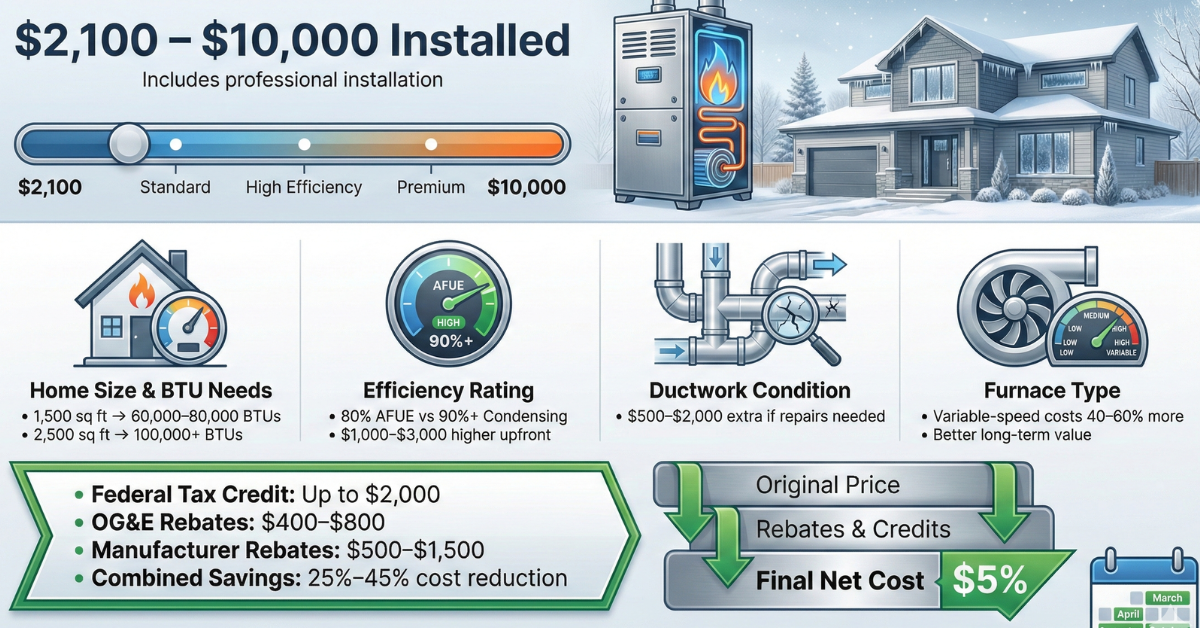
A new furnace in Oklahoma typically costs between $2,100 and $10,000 with professional installation, based on current pricing data from HomeGuide. Where you land in that range depends on the brand, efficiency level, furnace type, and the complexity of the installation.
Cost Factors That Affect Your Price
Several factors determine your final cost:
- Home square footage and BTU needs: Larger homes need higher-capacity furnaces. A 1,500 sq ft Oklahoma home typically needs 60,000 to 80,000 BTUs, while a 2,500 sq ft home may need 100,000+ BTUs. Our guide on calculating the right furnace size walks you through the process.
- Efficiency rating: Condensing furnaces (90%+ AFUE) cost $1,000 to $3,000 more upfront than 80% models but recover the difference through lower energy bills.
- Ductwork condition: If your existing ducts need sealing, repair, or modification, expect $500 to $2,000 in additional costs.
- Furnace type: Variable-speed models cost 40% to 60% more than single-stage but deliver the best long-term value.
Financial Incentives for Oklahoma Homeowners
Oklahoma homeowners can significantly reduce their out-of-pocket costs through available incentives:
- Federal tax credits: Up to $2,000 for qualifying high-efficiency HVAC equipment (must meet ENERGY STAR criteria)
- OG&E utility rebates: $400 to $800 for efficient system upgrades
- Manufacturer rebates: $500 to $1,500 depending on brand and timing
- Combined potential savings: 25% to 45% reduction in effective cost
Timing your purchase also matters. The best time for furnace installation in Oklahoma is typically early spring or early fall, when HVAC contractors offer off-season pricing and scheduling is more flexible.
What Should You Look for When Choosing a Furnace Installer?
The quality of your furnace installation often matters more than the brand name on the unit. Even the most expensive, highest-rated system will underperform if it isn’t installed correctly.
Consumer Reports confirmed this through their extensive survey of more than 500 HVAC specialists, finding that contractors cited “inadequate maintenance or improper installation twice as often as defective equipment” as the most common cause of furnace problems.
As VirHaac, a Michigan-based HVAC matching service, states: “A properly installed HVAC system can outperform a poorly installed top-tier unit. Installation and support matter more than the name on the box.”
Contractor Evaluation Checklist
When evaluating furnace installers, verify these non-negotiables:
- Manual J load calculation: Your contractor should calculate your home’s exact heating needs based on square footage, insulation, windows, ceiling height, and Oklahoma’s climate zone. A contractor who just matches the size of your old unit is skipping a critical step.
- Licensing and insurance: Verify current state licensing, general liability insurance, and workers’ compensation coverage.
- Brand experience: Ask specifically about their experience installing the brand you’re considering and whether they’re an authorized dealer.
- Detailed written quote: The quote should include the exact model number, AFUE rating, labor costs, permits, and everything included in the price.
- Labor warranty: Beyond the manufacturer’s parts warranty, your installer should guarantee their workmanship for at least one year.
- References and reviews: Check online reviews and ask for recent customer references in the Oklahoma City area.
After installation, don’t skip ongoing maintenance. A seasonal furnace tune-up can extend your system’s lifespan by years and help catch small issues before they turn into expensive repairs.
Making the Right Choice for Your Oklahoma Home
Choosing the best furnace for Oklahoma winters comes down to matching the right brand, efficiency level, and furnace type to your home’s specific needs. Here’s a quick recap:
- For premium comfort: Carrier Infinity series (98.5% AFUE, smart integration)
- For maximum efficiency: Lennox SLP99V (99% AFUE, quietest operation)
- For proven reliability: Trane or American Standard (Consumer Reports #1 reliability)
- For best value: Goodman or Amana (strong warranties, budget-friendly pricing)
- For most Oklahoma homes: A two-stage furnace with 95%+ AFUE is the sweet spot
The most important takeaway? Invest as much thought into choosing your installer as you do into choosing your furnace brand. Proper sizing through a Manual J calculation, correct installation, and regular maintenance will determine how well your system performs far more than any brand name.
If you’re ready to explore your options, AAdvantage Heating & Air Conditioning serves homeowners throughout Oklahoma City and the surrounding areas with honest advice, proper sizing, and professional installation. Reach out to our team to find the perfect furnace for your home.